

Five Questions Every Bank and Credit Union Should Be Asking About Their Vendor Relationships
 Vendor
management has matured significantly across the banking industry over the past
decade. Most banks and credit unions have formal programs in place: dedicated
oversight functions, documented processes, regulatory compliance. The
infrastructure exists.
Vendor
management has matured significantly across the banking industry over the past
decade. Most banks and credit unions have formal programs in place: dedicated
oversight functions, documented processes, regulatory compliance. The
infrastructure exists.What
often lags is the quality of the questions being asked.
Strong
vendor management programs are built on more than policies and procedures.
They're built on the right questions, asked consistently, at every stage of the
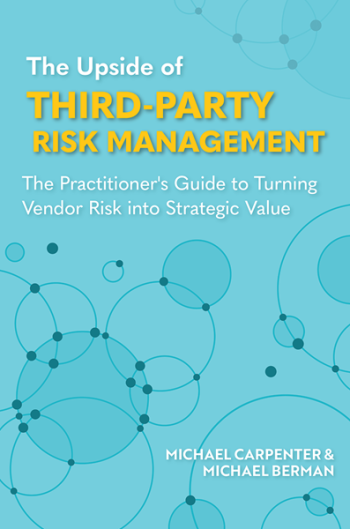
vendor relationship. It's a theme we explore throughout The Upside of
Third-Party Risk Management. The institutions that get this right are the
ones whose oversight connects directly to how they operate, regardless of team
size or technology investment.
These
five questions are a good place to start.
1.
Which of our business processes depend on this vendor?
Most
vendor assessments focus only on the vendor itself, including financial
stability, security controls, and compliance posture. Those are necessary
inputs. But they don't answer another important question: how deeply does your
institution depend on that vendor to execute its core functions?
Dependency
isn't always visible at the contract level. It builds over time as integrations
deepen, workflows adapt, and institutional knowledge concentrates around a
single provider. A vendor that started as a single-function tool five years ago
may now sit inside multiple critical processes, and the oversight program may
still reflect the original relationship, not the current one.
Mapping
business processes to vendor relationships, rather than evaluating vendors in
isolation, gives institutions a clearer picture of where exposure sits. That
clarity changes how oversight resources are allocated and how contingency
planning gets prioritized.
2.
Where are our single points of failure?
Every
institution has them. The question is whether they've been identified or if
they'll surface for the first time during a disruption.
Single
points of failure emerge when a critical business process depends on one
vendor, one integration, or one system with no viable alternative. They also
emerge at the ecosystem level when multiple processes share a common vendor or
infrastructure layer that individual assessments don't reveal.
Identifying
them requires looking across the vendor portfolio, not just within it. Which
vendors support multiple critical processes? Where do dependencies concentrate?
Which relationships, if disrupted, would ripple across several functions
simultaneously? Institutions that map these concentrations before a disruption
occurs are far better positioned to make informed decisions about redundancy,
contingency planning, and operational resilience.
3. Can
our vendors support the competitive commitments we've made to customers and
members?
Most
vendor assessments stop at risk. Those are necessary questions, but they rarely
ask whether vendor performance meets the specific commitments the institution
has made to compete.
If
leadership has committed to extended service hours or loan response times that
match the best players in the market, those promises carry upstream
requirements. Vendors embedded in those processes either support the target or
they don't — and an assessment that never asks the question won't catch the
gap.
4. How
would a significant disruption with this vendor affect our members or
customers?
This
question reorients vendor management around outcomes rather than processes.
It's straightforward to confirm that a vendor has met its contractual
obligations. It's harder and more valuable to think through what the member or
customer experience would look like if that vendor's performance degraded
significantly or failed.
Which
vendors touch the customer experience directly? Which ones support the
infrastructure that experience depends on? What early signals would indicate
deteriorating performance before it reaches the point of visible disruption?
Community
financial institutions have particularly strong reasons to center vendor
oversight around this question. Service quality and relationship depth are core
to how they compete. Keeping that customer and member lens active throughout
the vendor management lifecycle, and not just during incident response, is what
separates programs that protect the business from programs that merely satisfy
it.
5. How
quickly could we continue operating if this vendor became unavailable?
Exit
planning is one of the most consistently underdeveloped areas of vendor
management. Contracts often include termination provisions. What they
frequently lack is a realistic plan for what happens in the days and weeks that
follow.
This
question forces a practical assessment of operational resilience: Can the
institution migrate to an alternative provider within a timeframe that protects
customers and members? Are the data portability provisions in the current
contract sufficient to support that transition? Has the institution tested its
assumptions about how long a transition would take?
 For
community banks and credit unions, this question carries particular weight.
Smaller institutions often have few alternatives and long transition timelines,
which makes the cost of an unplanned vendor exit significant. Planning for that
scenario deliberately, before it becomes urgent, is far less expensive than
managing it under pressure.
For
community banks and credit unions, this question carries particular weight.
Smaller institutions often have few alternatives and long transition timelines,
which makes the cost of an unplanned vendor exit significant. Planning for that
scenario deliberately, before it becomes urgent, is far less expensive than
managing it under pressure.Asking
Better Questions
The
goal of vendor risk management isn't to satisfy an examiner. It's ensuring an
institution can execute its strategy, serve its members and customers, and
respond to disruption without being caught off guard by dependencies it didn't
know it had.
 These
questions require deliberate effort, cross-functional collaboration, and a
willingness to look beyond individual assessments toward the broader ecosystem
of relationships that supports how the institution operates. The institutions
that do that work well discover that stronger vendor oversight and better
business performance aren’t just compatible. They’re inseparable.
These
questions require deliberate effort, cross-functional collaboration, and a
willingness to look beyond individual assessments toward the broader ecosystem
of relationships that supports how the institution operates. The institutions
that do that work well discover that stronger vendor oversight and better
business performance aren’t just compatible. They’re inseparable.About
Author:
Co-authored by Ncontracts Founder and CEO Michael Berman and VP of Risk Management Michael Carpenter. The Upside of Third-Party Risk Management is available on Amazon in both softcover and eBook formats.
Co-authored by Ncontracts Founder and CEO Michael Berman and VP of Risk Management Michael Carpenter. The Upside of Third-Party Risk Management is available on Amazon in both softcover and eBook formats.